Why can’t you just use a standard monitor on the factory floor?
A typical consumer-grade monitor brought into a workshop rarely lasts more than a quarter: iron dust infiltrates the screen, coolant corrodes the bezel, and the unit overheats and goes black during the summer. Industrial touch-screen monitors aren't just "reinforced"—they are designed from the ground up with the expectation of continuous operation for a decade.
I. How standard monitors "die" in a workshop
Dust clogs cooling vents, causing the backlight to age prematurely. Oil mist and cutting fluids—often slightly alkaline—corrode the bezel coating over time. Machine tool vibrations can loosen internal ribbon cables, leading to screen flickering. Electromagnetic interference (EMI) from variable-frequency drives (VFDs) and servo drives causes touch-input drift or "ghost" touches. Furthermore, extreme temperatures—ranging from sub-zero in winter to 50°C inside control cabinets in summer—can severely degrade the response time and contrast of an LCD panel. Any one of these issues is enough to bring a production line to a standstill.
II. Four critical benchmarks
First: Protection. The front panel must meet the IP65 standard—dust-tight and resistant to water jets—along with an IK06 impact-resistance rating, ensuring the screen won't shatter if struck by a tool.
Second: Temperature. The unit must operate between -10°C and 70°C and withstand storage temperatures from -30°C to 80°C, covering the vast majority of workshop and control-cabinet environments.
Third: Continuous operation. Designed for 24/7 uptime, these units feature specialized internal airflow channels that dissipate heat while maintaining a fully sealed enclosure.
Fourth: Electromagnetic Compatibility (EMC). The entire unit must be EMC-certified, ensuring that both the display and touch functions remain stable even when placed next to VFDs or other high-interference equipment.
III. Why projected capacitive (PCAP) touch has become the industry standard
Projected capacitive (PCAP) technology offers distinct advantages for industrial settings: it supports 10-point multi-touch, provides high positioning accuracy, features a completely flat, bezel-free surface, and facilitates a fully sealed design. When paired with industrial-grade touch controllers and specialized algorithms, these screens remain functional even when the user is wearing thin gloves or when water droplets are present on the display surface. For the display surface, you can choose from AG (anti-glare), AR (anti-reflective), or AF (anti-fingerprint) coatings based on your specific needs; in environments with intense lighting—such as factory floors—an AG coating is almost always essential.
IV. Interfaces and Mounting: Avoid On-Site Surprises
Video input options typically include VGA, DVI, HDMI, and DP, while touch functionality is handled via a separate USB Type-B port. If you opt for an all-in-one touch panel PC, a computing unit is integrated directly into the device. Mounting options include flush-mount (embedded), desktop, and cantilever (arm-mounted) configurations. The rear of the unit features standard VESA mounting holes, and all interfaces are conveniently located at the bottom or lower-rear to facilitate clean cable management. Available screen sizes range from 10.1 to 23.8 inches, with both 4:3 and 16:9 aspect ratios offered—a crucial detail, as retrofitting older equipment often requires a 4:3 form factor.
V. A Concise Selection Checklist
Begin by verifying the mounting cutout dimensions and the panel's aspect ratio. Next, determine the required ingress protection (IP) rating—such as whether the unit needs to withstand washdowns—as well as the operating temperature range, the necessity for 24/7 continuous operation, and the required interface types and cable lengths. Finally, ask three key questions: Is the panel an industrial-grade "A+" original display? Does the unit carry EMC and CE/FCC/RoHS certifications? And can the supplier guarantee product availability throughout the entire lifecycle of your project?
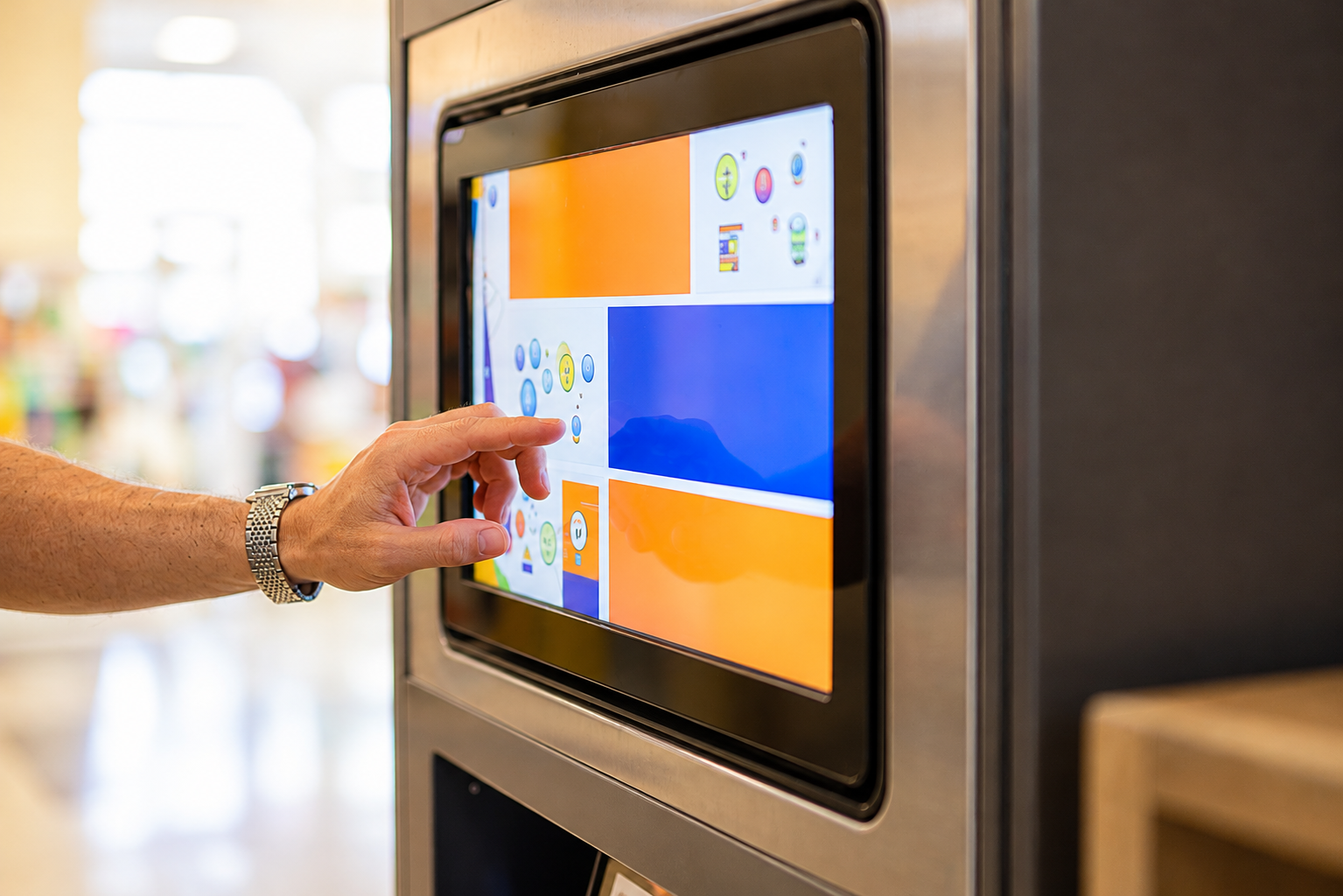
The LMENGER 3K series of industrial capacitive touch displays covers sizes from 10.1 to 23.8 inches. These units feature an IP65-rated front panel, IK06-rated impact resistance, and an operating temperature range of -10°C to 70°C. They are designed for 24/7 operation and come equipped with VGA, DVI, HDMI, and DP video inputs, along with a USB interface for touch functionality.